ايكوسودان نت التنمية مستقبلنا



مقالات مشابهة
The plant is designed to double the country’s energy production and generate a surplus for export to neighboring countries, including Sudan, Kenya, Djibouti and Tanzania.
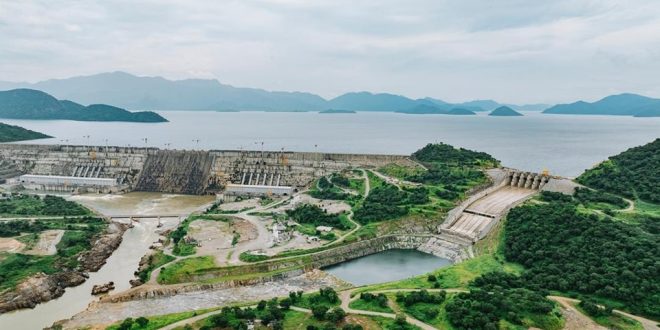
Formerly known as the Millennium Dam and sometimes referred to as the Hidase Dam, the Grand Ethiopian Renaissance Dam (GERD) is located on the Blue Nile River in Ethiopia. The dam is located in the Metekel area of the Benishangul-Gumuz region, near the border with Sudan. Commissioned by Ethiopian Electric Power (EEP), built by the Italian company Webuild (formerly Salini Impregilo), and inaugurated on September 9, 2025, the project is the largest hydroelectric project in Africa and among the 20 largest in the world, with an installed capacity of 5,15 gigawatts (GW), equivalent to three medium-sized nuclear power plants.
The main dam is 1.800 meters long, 170 meters high, and has a total RCC (roller compacted concrete) volume of 10,7 million cubic meters. The reservoir has a surface area of 1.875 square kilometers and a volume of 74 billion cubic meters. The project created a reservoir that collects rainwater and rivers and directs them to the main dam; an average annual flow of approximately 50 billion cubic meters is estimated. The facility is designed to double domestic energy production and generate a surplus for export to neighboring countries, including Sudan, Kenya, Djibouti, and Tanzania.
Beyond its technical significance, the GERD also holds strong strategic and institutional value: financed entirely by domestic funds and government bonds, it is a global-scale infrastructure that consolidates Ethiopia’s energy autonomy and its ability to position itself as a regional energy hub. The GERD is estimated to have cost approximately $5 billion, equivalent to 7 percent of Ethiopia’s 2016 gross domestic product (GDP). Ethiopia financed the project through crowdsourcing, raising funds internally through bond sales and convincing employees to contribute a portion of their incomes. Of the total cost, $1 billion for turbines and electrical equipment was financed by the Exim Bank of China. The main contractor for the GERD is the Italian company Webuild (formerly Salini Impregilo), which also served as the main contractor for the Gilgel Gibe II, Gilgel Gibe III, and Tana Beles dams.
The first filling phase of the reservoir began in July 2020, and in August 2020, the water level rose to an altitude of 540 meters. The second filling phase was completed on July 19, 2021, with water levels rising to an altitude of approximately 575 meters. The third filling was completed on August 12, 2022, at an altitude of 600 meters. The fourth filling was completed on September 10, 2023, with water levels at approximately 625 meters. The fifth and final filling was completed in October 2024, with a final water level at an altitude of approximately 640 meters. On February 20, 2022, the dam produced electricity for the first time, feeding 375 megawatts (MW) into the grid. A second 375 MW turbine was commissioned in August 2022. The third and fourth 400 MW turbines were commissioned in August 2024. The dam’s official inauguration took place on September 9, 2025.
On the diplomatic front, the construction of the GERD has caused significant regional tensions, straining Ethiopia’s relations with downstream Nile countries, particularly Egypt and Sudan. Cairo, which relies on the river for 97 percent of its water needs (primarily for agriculture), continues to invoke its historic rights to the river and claims that the GERD poses an “existential” threat to the country. Years of tripartite negotiations between Ethiopia, Sudan, and Egypt, conducted under the mediation of the United Nations and the African Union, have failed to resolve the dispute. Egypt and Sudan consider the GERD a persistent threat to stability in the eastern Nile basin, arguing that the dam violates international law and poses serious risks to downstream countries. The two countries denounce Addis Ababa’s “unilateral actions” to fill the pipeline, despite disagreements with Cairo and Khartoum, and cite concerns about the plant’s structural safety as well as the alleged risks associated with uncontrolled water releases and poor management during droughts. The Ethiopian government, for its part, has repeatedly accused downstream countries, particularly Egypt, of exerting undue pressure on the Arab League to side with Cairo.
Since November 2019, the United States has facilitated negotiations between the governments of Egypt, Ethiopia, and Sudan regarding the filling and operation of the GERD. In September 2020, the United States suspended some of its economic assistance to Ethiopia due to the lack of sufficient progress in negotiations with Sudan and Egypt over the construction of the dam. At the beginning of his second term in the White House, US President Donald Trump, sent a letter to the Egyptian president Abdel Fattah al-Sisi announcing its intention to mediate the crisis between Egypt, Sudan, and Ethiopia, suggesting implementing a mechanism that would equitably divide water between the three nations, while simultaneously allowing Ethiopia to generate substantial amounts of electricity.
Read also other news on Nova News